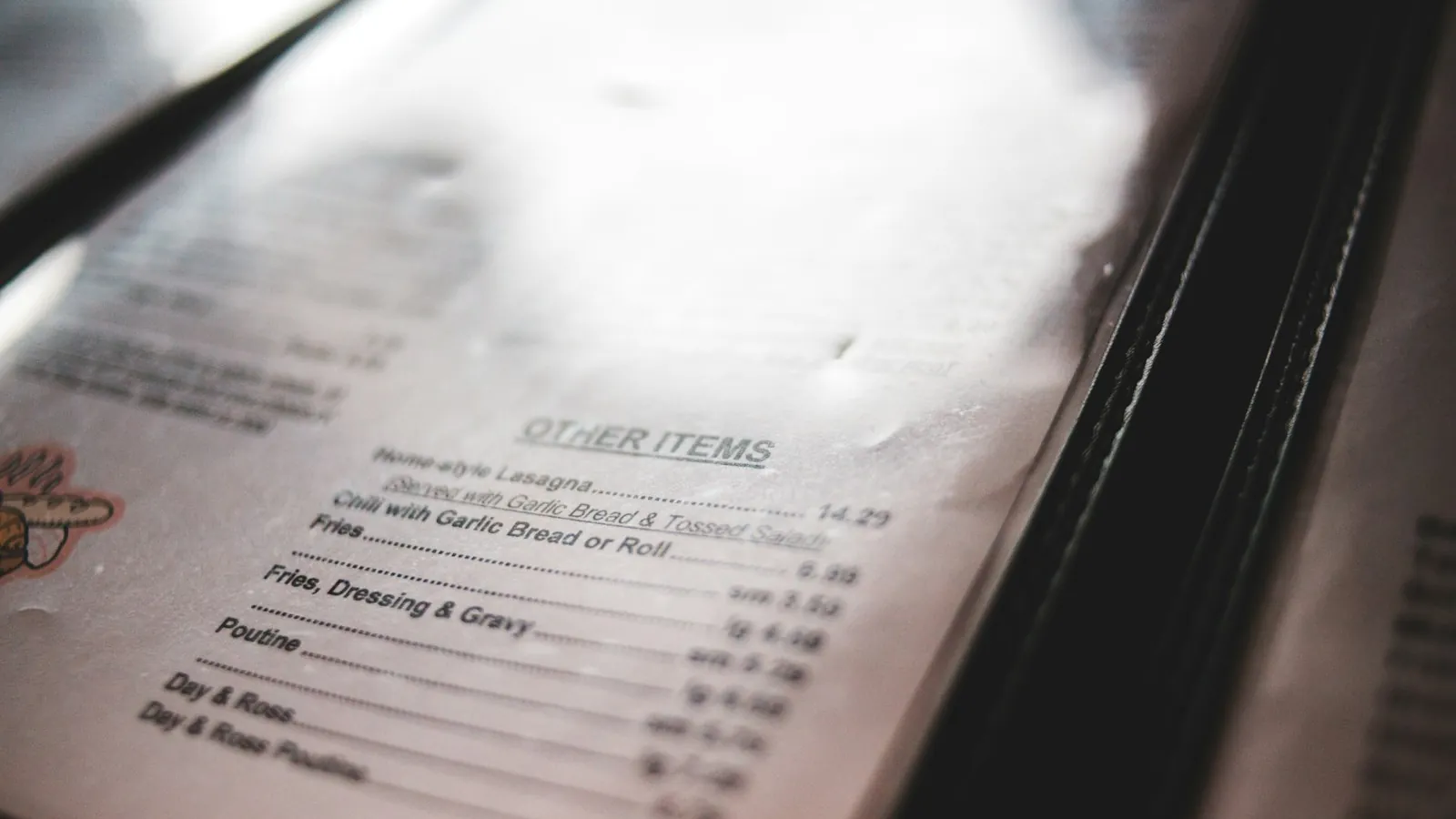
Every dish on a Chinese takeout menu has a code beside it. Most people ignore them, read the names, and then struggle to communicate the order over a phone. The codes are the most useful thing on the page and nobody explains them.
The letter is the section and the number is the position within it. So H07 is the seventh item in the
H section. Ordering by code is faster and far more accurate than ordering by name, because dish names
repeat across sections and codes do not.
How the system works
It is a two-part address: a letter for the section, a number for the item.
The letters are assigned in the order the sections appear on the menu, which is why appetizers are almost always A and beverages are near the end of the alphabet. The numbers restart at 1 in each section. That gives every dish a unique short label that can be said aloud without ambiguity.
Some menus use pure numbers running 1 to 200 instead. That works, but it is worse: a three-digit number carries no information about what part of the menu you are in, and a single transposed digit puts you in a different section entirely.

Why this matters more than it sounds
Because dish names are genuinely ambiguous on this kind of menu, in a way they are not on most others.
“Chicken with broccoli” can appear in the broccoli section, the chicken section, the diet section as a steamed version, and on a combination plate. Those are four different dishes at four different prices. Saying the name gets you a follow-up question; saying the code does not.
The same problem shows up with sizes, with house special versions, and with anything that exists as both a dish and a combination plate. Our guide to combination plates covers that last case, which is the one people most often order by accident.
There is also a plain practical benefit: codes survive a noisy phone line and an accent difference in both directions. “H zero seven” is unambiguous in a way “moo goo gai pan” is not, whoever is saying it.

What the letters typically mean
There is no industry standard, so the specific letters vary between restaurants. But the pattern is consistent: the letters follow the physical order of the menu.
| Code | Section | Example |
|---|---|---|
| A | Appetizers | A14 Crab Meat Rangoon |
| B | Soups | B01 Wonton Soup |
| C | Chow Mein and Chop Suey | C02 Roast Pork Chow Mein |
| D | Noodle dishes | D10 Roast Pork Lo Mein |
| E | Fried Rice | E01 Roast Pork Fried Rice |
| G | Beef | G01 Pepper Steak with Onion |
| H | Pork and Chicken | H07 Moo Goo Gai Pan |
| I | Seafood | I04 Shrimp with Lobster Sauce |
| K | Special Food (fried items) | K01 Fried Chicken Wings |
| M | Combination plates | M05 Pepper Steak (CP) |
| S | Chef’s Specials | S32 Coconut Chicken |
| V | Vegetables | V03 Broccoli with Garlic Sauce |
Two features of real menus show up in that table. Letters get skipped — there is no F or L in that list at the top level — because sections get added and removed over the years while the existing codes stay put. And one letter sometimes covers two related sections, as H does for pork and chicken here.
Why the codes are never renumbered
This is the interesting part, and it explains the gaps and oddities on every menu you have ever read.
Once a code is in circulation it is effectively permanent. Regulars order by it. Staff know it. It is printed on takeout menus in a thousand kitchen drawers. Renumbering to tidy up the gaps would invalidate all of that at once, so kitchens simply do not.
The result is an archaeological record. A missing number usually means a dish that was dropped. A dish appended at the end of a section out of alphabetical order was added later. A high number in a small section means that section used to be bigger.
It also means the codes outlast the prices, the design and sometimes the ownership. Ours came through a full site rebuild intact, because changing them would have been a worse decision than keeping them.
Using them well
Do this
- Read the code aloud, then the name
- Say the letter clearly — “H as in hotel”
- Write codes down for a group order
- Keep a note of your usual codes
Watch for
- The same dish in two sections at two prices
- Combination plate versions with their own codes
- Small and large sizes under one code
- Codes differing between the print and web menus
The last point is worth a check. If a restaurant’s paper menu and website were produced at different times, the codes may not match, and the kitchen works from one of them. If a code and a name disagree, say both and let them resolve it.
Our guides to asking for changes and ordering by phone or online both come back to the same practical point: name the code.
The one thing codes cannot tell you
What is in the dish.
A code is an address, not a description. S24 is a perfectly precise way to order Hawaiian Five “O” and
tells you nothing whatsoever about what will arrive. For that you need either the name to be descriptive — our
guide to menu words covers which names actually
decode — or a question at the counter.
So the codes solve communication, not comprehension. Use them to be understood, and ask questions to understand.
Frequently asked questions
What do the numbers on a Chinese menu mean?
The letter identifies the section and the number identifies the item’s position within it, so
H07 is the seventh item in the H section. Together they give every dish a unique short label that can be
said aloud without ambiguity.
Is it better to order by number or by name?
By number, or better still both. Dish names repeat across sections at different prices — chicken with broccoli can appear in four places — while codes are unique. Codes also survive a noisy phone line far better than dish names do.
Why are some numbers missing from the menu?
Because dishes were dropped and the codes were never renumbered. Once a code is in circulation regulars order by it, so renumbering would invalidate every takeout menu in a customer’s drawer. The gaps are a record of what the menu used to be.
Do all Chinese restaurants use the same codes?
No. There is no industry standard, so the letters and numbers differ between restaurants. The pattern is consistent, though: letters follow the physical order of the sections down the menu, and numbers restart at 1 in each section.
Can the code tell me what is in a dish?
No. A code is an address rather than a description. It makes you precise about which dish you want, not informed about what will arrive. For that you need a descriptive name or a question at the counter.
The short version
Letter for the section, number for the position. Unique, unambiguous, and never renumbered — which is why the gaps and oddities are permanent.
Order by code and by name together. The code gets you understood; only a question gets you informed.
Order from China King
Have the codes ready and the call takes a fraction of the time.
Sources
- American Chinese cuisine — on how these menus are structured and how they developed.