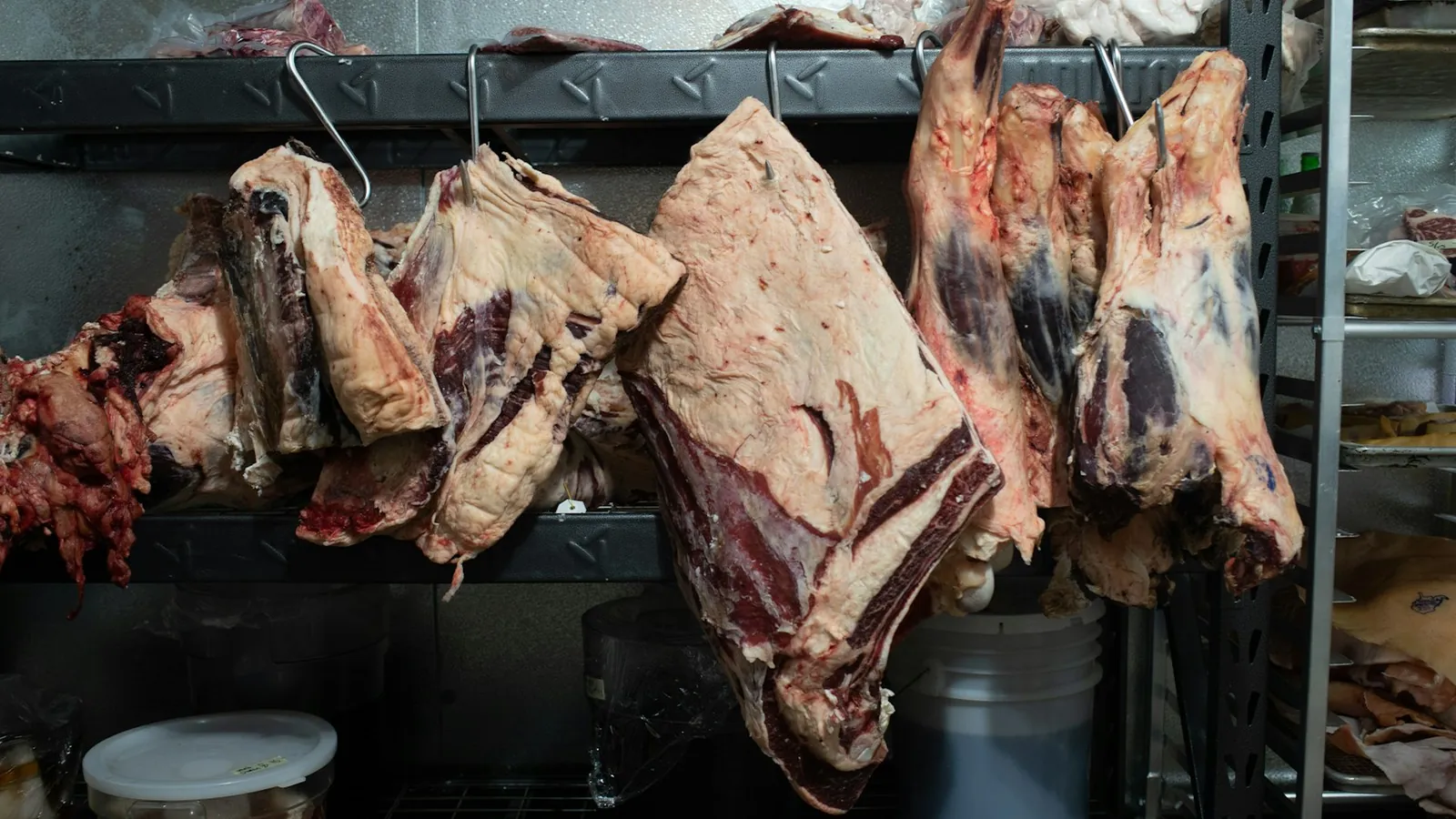
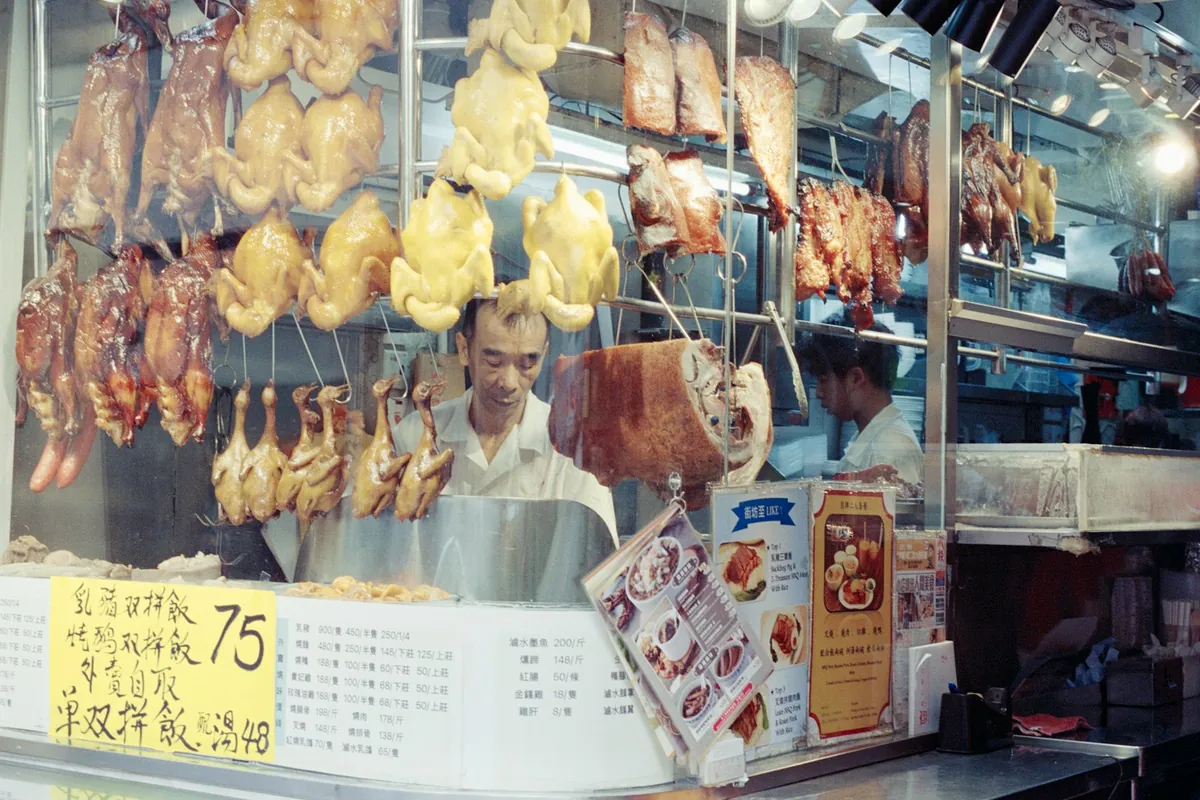
In any Chinatown there is a window with ducks hanging in it, glazed mahogany brown, alongside strips of red pork and whole chickens. It looks like a display and it is actually a functioning cooking method, and the shop behind it is a distinct trade from the restaurant next door.
Siu mei is Cantonese roast meat — duck, pork, chicken and pork belly, roasted in tall ovens and hung on hooks. The hanging is functional: air circulation keeps the skin dry and crisp. Meat is chopped to order and sold by weight, usually over rice.
Why the meat hangs
Because skin needs air, and lying on a surface is the one thing that ruins it.
A roast duck or a strip of char siu comes out of the oven with a rendered, crisp surface. Put it on a tray and the underside sits in its own moisture and fat, and within minutes that part of the skin goes soft. Hang it from a hook and air reaches every surface equally.
The same logic applies during cooking. These ovens are tall vertical cabinets, and the meat hangs inside them so heat circulates all the way round and fat drips away rather than pooling. Our guide to Peking duck covers the same principle in its most refined form.
So the window display is not marketing that happens to look good. It is the correct way to hold the product, and the fact that it draws people in is a fortunate side effect.
What is actually hanging there
| Item | What it is | Notes |
|---|---|---|
| Char siu | Marinated roast pork, red-edged | The one that reached American menus |
| Roast duck | Whole duck, crisp skin, savory | The centerpiece of most counters |
| Soy sauce chicken | Poached in seasoned soy, not roasted | Glossy brown, tender, mild |
| Crispy pork belly | Roasted with a blistered, crackling skin | The textural showpiece |
| Roast goose | Richer and rarer than duck | A regional specialty where available |
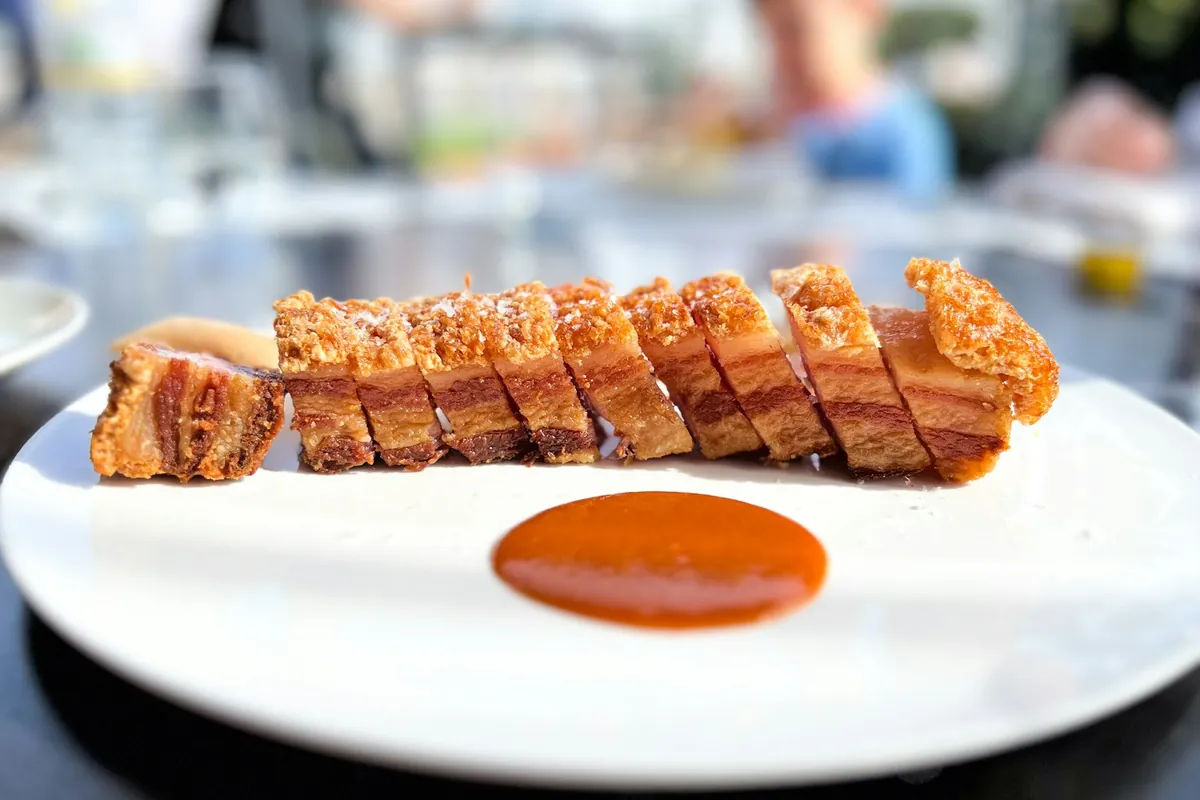
Crispy pork belly is worth singling out. The skin is dried, salted and roasted until it blisters into a genuinely crunchy layer over soft fat and meat, and the contrast is unlike anything on an American Chinese menu. If you visit one of these shops once, this is the thing to order.
Soy sauce chicken is the outlier: it is poached rather than roasted, which is why its skin is glossy and smooth rather than crisp. It hangs alongside the roasts by convention rather than by method.
How to order
Differently from a restaurant, and the difference confuses first-timers.
You order by the item and the portion — a quarter duck, half a pound of char siu — and the counter chops it to order with a cleaver, bones and all. Our guide to Chinese cooking equipment covers the heavy cleaver that does this, which is a different tool from the thin vegetable one.
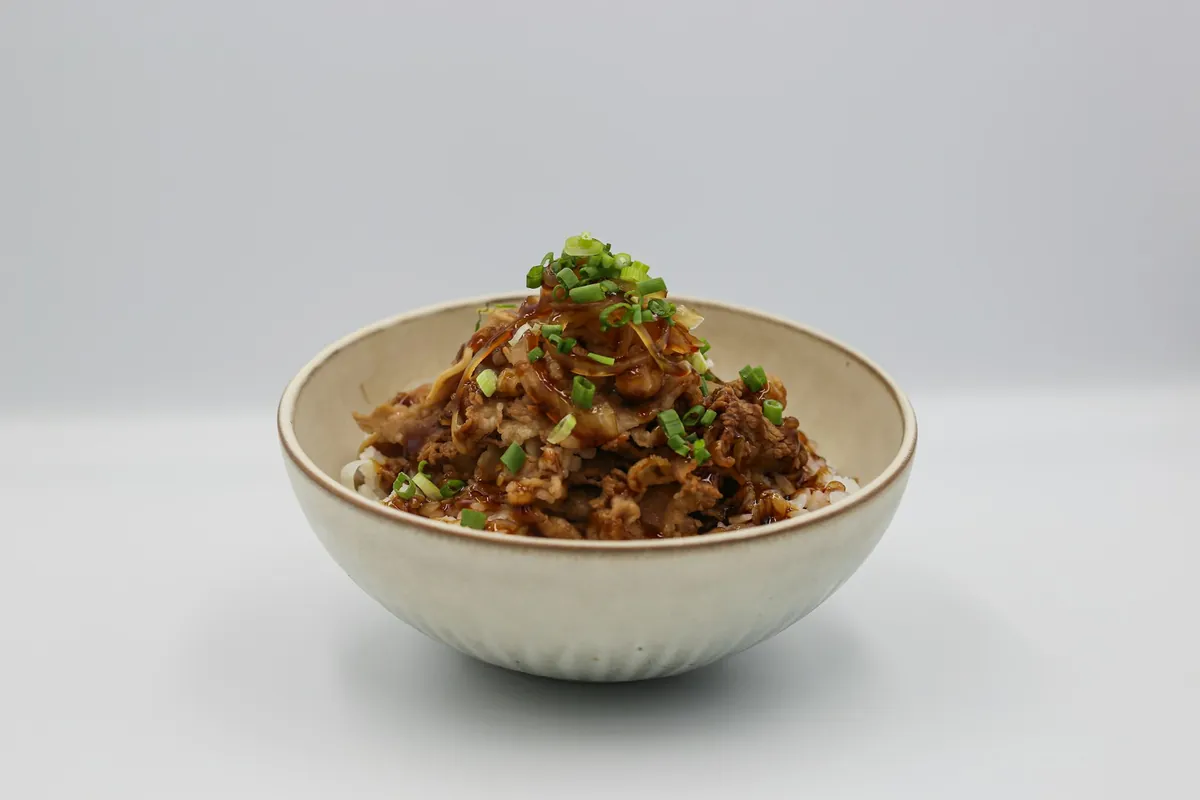
The default serving is over rice, in a box, with a little sauce from the roasting and usually some blanched greens. That combination — meat, rice, greens — is the standard cheap lunch across Hong Kong and Cantonese communities everywhere.
How to order well
- Over rice, for a complete meal
- Ask for a mix — two meats on one box
- Take the sauce they offer
- Go at lunchtime, when turnover is highest
What to expect
- Bones in the duck; it is chopped, not carved
- Fast service, minimal ceremony
- Cash-friendly, often counter-only
- Skin softening within about twenty minutes
The bones are the thing worth knowing in advance. Chinese roast duck is cleavered through the bone into segments rather than filleted, so a portion contains bone. That is normal and expected, not an error.
The connection to your takeout menu
There is one, and it is direct: char siu is the roast pork on an American Chinese menu.
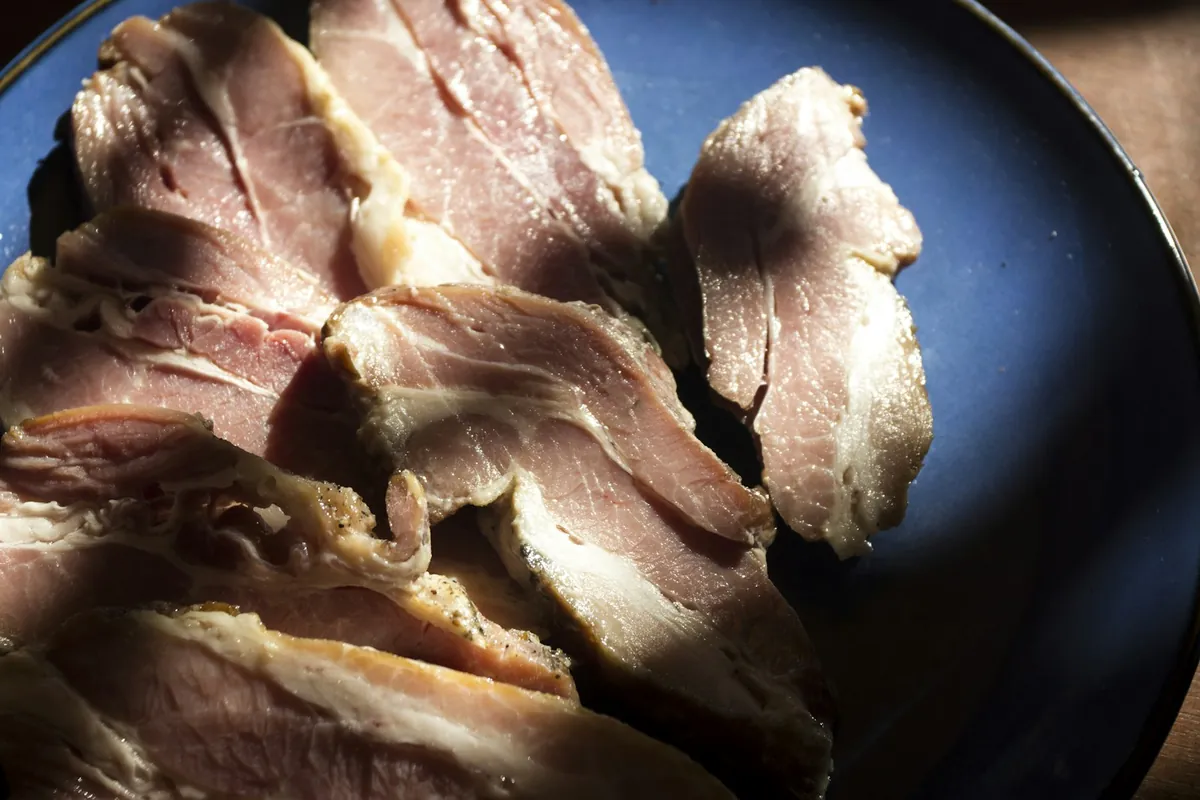
The sliced pork with reddish edges that runs through the fried rice, the lo mein, the egg foo young and its own menu section is the same product that hangs in a Chinatown window, adapted for a kitchen that needs it pre-cooked and ready to slice. Our guide to roast pork covers how far it travels across a menu, and our guide to five spice covers the seasoning in its marinade.
So the siu mei tradition did reach American takeout, but only one item of it did. Duck, pork belly and soy sauce chicken all require a specialist oven and a whole-bird supply chain that a wok-and-fryer kitchen has no way to run — our guide to how takeout kitchens work covers that constraint.
Finding one
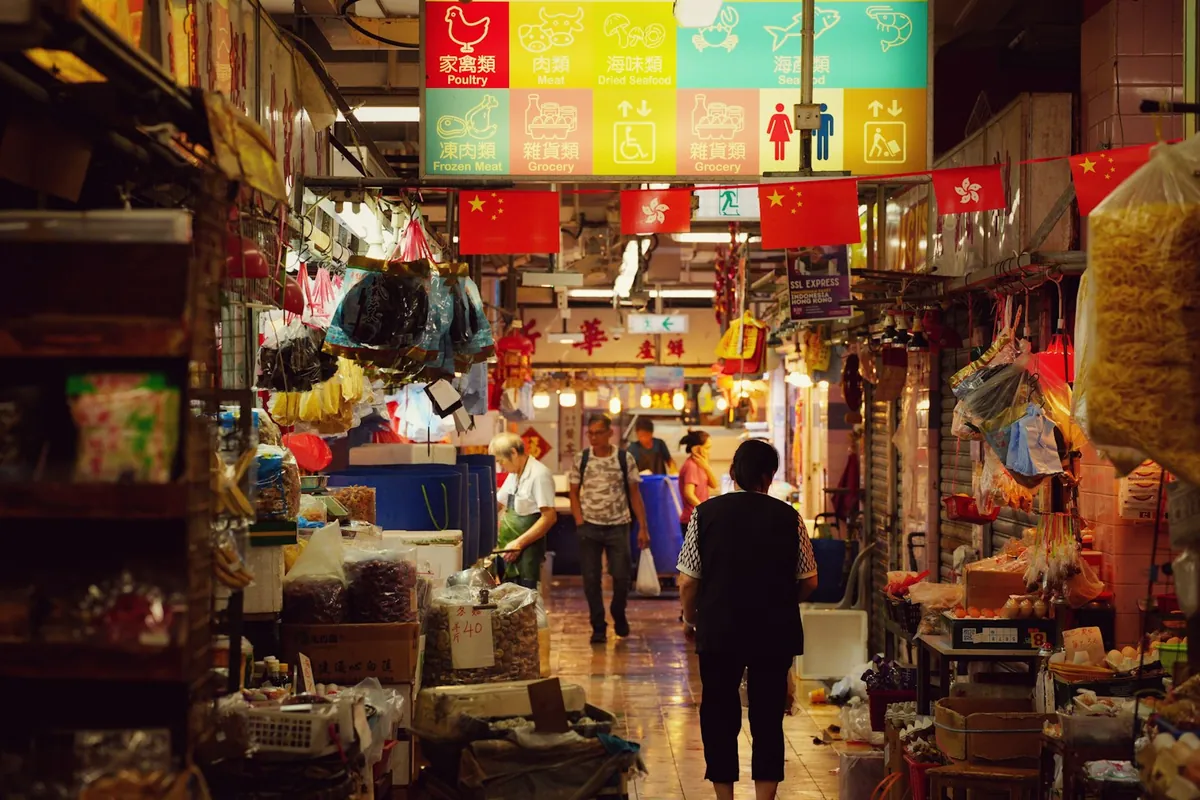
Cities with substantial Chinese communities, usually in a Chinatown or an Asian shopping plaza, frequently attached to or adjacent to a restaurant. They are often unglamorous, counter-service places with fluorescent lighting and a queue at lunchtime.
The queue is the signal worth reading. These shops live on turnover: meat roasted this morning and sold by early afternoon. A busy counter means the duck came out recently, and a quiet one at three in the afternoon means it has been hanging a while. Our guide to judging a Chinese restaurant makes the same point about turnover generally.
And eat it soon. Crisp skin has the same clock as anything fried — our guide to pickup or delivery covers it. A roast duck twenty minutes into a car journey is still good; it is not what it was in the shop.

Frequently asked questions
Why do Chinese restaurants hang ducks in the window?
Because air circulation keeps the skin dry and crisp. Laid on a tray, the underside sits in its own moisture and softens within minutes. Hanging is the correct way to hold the product; the window display is a side effect.
What is siu mei?
Cantonese roast meats — duck, char siu pork, soy sauce chicken and crispy pork belly — cooked in tall vertical ovens and hung on hooks. It is sold by weight, chopped to order, usually served over rice with greens.
Is the roast pork on a takeout menu the same as char siu?
Essentially yes. The sliced pork with reddish edges running through fried rice, lo mein and its own section is char siu adapted for a kitchen that needs it pre-cooked and ready to slice. It is the one siu mei item that crossed over.
Why is the duck chopped with bones in?
Because Chinese roast duck is cleavered through the bone into segments rather than filleted. A portion containing bone is normal and expected rather than a mistake, and the heavy cleaver used for it is a different tool from the thin vegetable cleaver.
What should I order at a Chinese BBQ shop?
Crispy pork belly if you are trying one thing, for the blistered skin over soft fat. Otherwise a mixed box over rice with two meats. Go at lunchtime, when turnover is highest and the meat came out most recently.
The short version
Cantonese roast meats, cooked hanging in tall ovens and held hanging because that is what keeps skin crisp. Chopped to order, sold by weight, eaten over rice.
One item made it onto American takeout menus: char siu, the roast pork. The rest needs a different kind of shop.
Order from China King
Roast pork is the siu mei tradition on our menu, across eight sections.